Is WordPress Dying in 2026? The Real Future of WordPress Explained
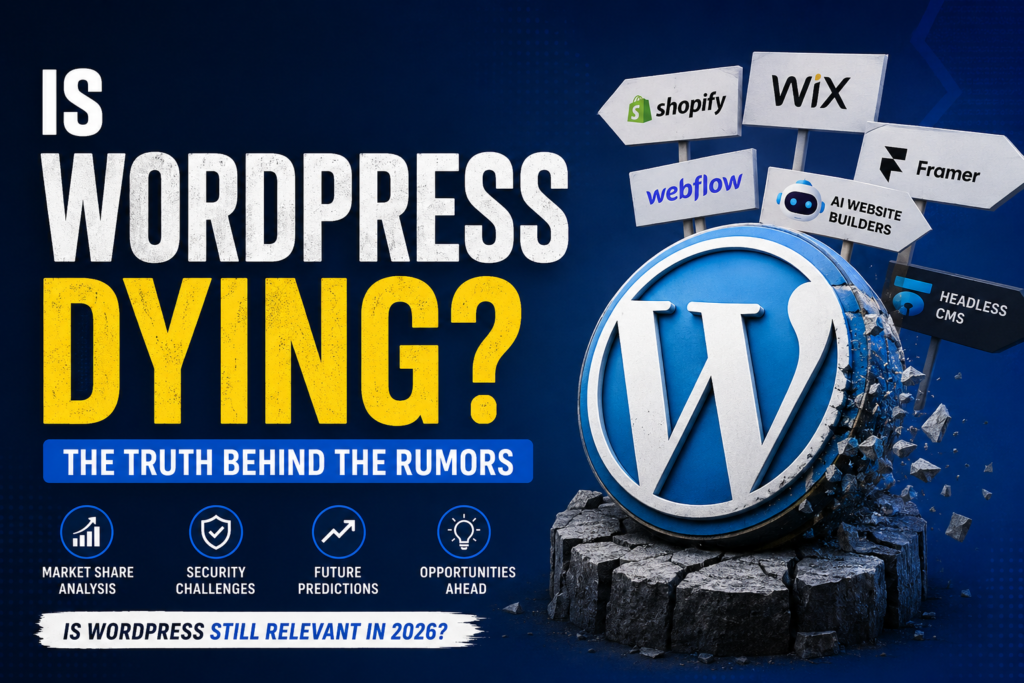
Is WordPress Dying in 2026? The Truth Behind the Rumors
Let’s be honest—if you’ve spent any time in web development circles lately, you’ve probably heard the doom-and-gloom predictions. “WordPress is dying.” “Nobody uses WordPress anymore.” “AI will replace WordPress completely.”
I get it. When you see shiny new platforms like Webflow making waves, Shopify dominating e-commerce, and AI website builders promising to create entire sites in minutes, it’s easy to wonder: Is WordPress dying?
The short answer? No. But the longer answer is far more interesting—and it’s exactly what we’re going to unpack in this article.
Why Everyone Thinks WordPress Is Dying (And Why They’re Not Entirely Wrong)
Here’s the thing: the people saying WordPress is dying aren’t just making it up. They’re seeing real shifts in the industry, and some of their concerns are completely valid.
The Rise of No-Code Platforms
Walk into any startup office in 2026, and you’ll find someone who built their entire website on Webflow without writing a single line of code. Or a small business owner who launched their online store with Shopify in an afternoon.
These platforms are incredibly appealing:
- They’re visual and intuitive
- They require zero technical knowledge
- They come with hosting, security, and updates built-in
- They promise “no maintenance headaches”
Compare that to WordPress, where you need to worry about plugins, themes, updates, security patches, and hosting configurations. The friction is real.
The Gutenberg Controversy
Let’s talk about the elephant in the room: Gutenberg.
When WordPress introduced the block editor in 2018, the community split right down the middle. Some people loved the modern, flexible approach. Others absolutely hated it.
I’ve talked to developers who switched to headless CMS solutions purely because they couldn’t stand Gutenberg. I’ve also talked to users who found it confusing and clunky compared to the old classic editor.
The problem? WordPress tried to compete with page builders like Elementor and Divi, but ended up creating something that satisfied neither the code-first developers nor the drag-and-drop enthusiasts. That middle ground became a no-man’s-land for many users.
Plugin Overload and Performance Nightmares
Here’s a scenario you might recognize:
You install WordPress. It’s fast and clean. Then you add a page builder. Then an SEO plugin. Then a contact form. Then a caching plugin. Then a security plugin. Then an analytics tool. Then…
Suddenly, your site loads in 8 seconds instead of 2. Half your plugins conflict with each other. One plugin hasn’t been updated in three years and might be a security risk.
This is the WordPress paradox: its greatest strength (flexibility through plugins) is also its biggest weakness. Modern alternatives like Framer or Squarespace don’t have this problem because they control the entire ecosystem.
Security Concerns Are Real
Let’s not sugarcoat this: WordPress sites get hacked. A lot.
Why? Because WordPress powers 43% of all websites. It’s the biggest target on the internet. Outdated plugins, weak passwords, and poor hosting configurations create endless vulnerabilities.
Meanwhile, platforms like Shopify or Wix handle security on their end. You literally can’t mess it up because you don’t have access to the underlying infrastructure.
For business owners who just want a website that works, that peace of mind is worth everything.
The AI Website Builder Revolution
This is the newest threat—and honestly, the most interesting one.
In 2026, you can literally tell an AI: “Build me a website for my coffee shop in Portland with a menu, online ordering, and a blog.” Five minutes later, you have a functional website.
Tools like 10Web AI, Wix ADI, and various GPT-powered builders are making website creation almost conversational. Why would someone spend weeks learning WordPress when they can describe what they want and get it instantly?
But Here’s What the “WordPress Is Dead” Crowd Gets Wrong
Now that we’ve acknowledged the legitimate concerns, let’s talk about why the death predictions are premature—and honestly, probably wrong.
WordPress Still Powers 43% of the Internet
Let me say that again: 43% of all websites run on WordPress.
That’s not a dying platform. That’s a dominant platform that’s so deeply embedded in the internet’s infrastructure that it’s not going anywhere soon.
For context:
- Shopify powers about 4% of websites
- Wix is around 2%
- Squarespace is less than 2%
WordPress isn’t just ahead—it’s in a different league entirely.
The Enterprise and Agency Market Isn’t Going Anywhere
Here’s what most “WordPress is dying” articles miss: the vast majority of professional developers and agencies aren’t building personal blogs or simple brochure sites.
They’re building:
- Complex membership platforms
- Custom LMS systems
- Multi-vendor marketplaces
- Publishing empires with thousands of posts
- Enterprise portals with intricate user permissions
- Multilingual sites with complex taxonomies
Try building any of that on Wix. I’ll wait.
WordPress isn’t competing with Squarespace for the “I need a website for my yoga studio” market. It’s competing with custom PHP frameworks, Laravel, and enterprise CMS solutions—and it’s winning because it offers the flexibility of custom code with the efficiency of a proven platform.
WooCommerce Is Still an E-Commerce Powerhouse
Yes, Shopify is fantastic for standard e-commerce. But WooCommerce powers 26% of all online stores—and it’s the go-to solution for:
- Businesses that need complete control over their data
- Complex product configurations (subscriptions, bookings, memberships)
- Integration with existing WordPress content sites
- Custom checkout flows and business logic
- Merchants who want to avoid platform fees
I know a company making $2 million annually through WooCommerce. When I asked why they didn’t switch to Shopify, the owner said: “Why would I give Shopify 2% of my revenue plus transaction fees when I can run it myself for a fraction of that cost?”
The Developer Community Is Massive and Active
WordPress isn’t maintained by a small team—it’s backed by thousands of developers, billions of dollars in plugin/theme revenue, and companies like Automattic (valued at $7.5 billion).
The ecosystem includes:
- 60,000+ plugins
- 10,000+ themes
- Thousands of developers releasing updates daily
- Active forums, communities, and resources
- Enterprise-level support options
Compare that to newer platforms that might look shiny but have tiny communities. When you hit a wall with WordPress, you can find a solution. When you hit a wall with a niche platform, you’re stuck.
WordPress Is Evolving (Even If Painfully)
Gutenberg was controversial, but it’s getting better. The Full Site Editing (FSE) features introduced in recent versions are genuinely powerful. Block patterns, reusable blocks, and the Site Editor are moving WordPress toward a more modern, flexible architecture.
Is it perfect? No. Is it catching up? Absolutely.
More importantly, WordPress is embracing the headless CMS movement. You can use WordPress as a backend content manager and build your front end with React, Next.js, or Vue. This “best of both worlds” approach is attracting a new generation of developers who want WordPress’s content management power without its front-end limitations.
WordPress vs The Competition: A Practical Comparison
Let’s get specific about how WordPress stacks up against its biggest competitors in 2026.
WordPress vs Shopify
Shopify wins if:
- You’re building a standard online store
- You want zero technical maintenance
- You don’t mind monthly fees and transaction costs
- You need fast setup
WordPress (WooCommerce) wins if:
- You need complex product configurations
- You want complete control over your data
- You’re integrating e-commerce with content marketing
- You want to minimize long-term costs
- You need custom functionality
WordPress vs Webflow
Webflow wins if:
- You’re a designer who wants visual control
- You’re building modern marketing sites
- You prefer clean, minimal code output
- You don’t need extensive third-party integrations
WordPress wins if:
- You need the plugin ecosystem
- You’re building complex, content-heavy sites
- You want multiple developer options
- You need proven long-term stability
WordPress vs AI Website Builders
AI Builders win if:
- You need something basic and fast
- You have zero technical knowledge
- Your needs are simple and standard
- You’re okay with limited customization
WordPress wins if:
- You need specific functionality
- You’re growing and need scalability
- You want full ownership and control
- You need SEO flexibility and power
The Real Future of WordPress in 2026 and Beyond
So what’s actually happening with WordPress? Here’s my honest assessment after watching this industry for years:
WordPress Isn’t Dying—It’s Specializing
WordPress is moving away from being “the solution for everything” to being the solution for specific use cases:
- Content-driven websites (blogs, publications, news sites)
- Complex e-commerce (beyond simple product catalogs)
- Membership and community sites
- Enterprise and agency projects
- Headless CMS implementations
For a basic brochure site or simple portfolio? Yeah, Squarespace might be easier. But for anything with real complexity, WordPress remains unbeatable.
The WordPress Developer Market Is Changing, Not Disappearing
If you’re a WordPress developer building simple blogs for $500, you might struggle. But if you’re offering:
- WooCommerce customization
- Headless WordPress implementations
- Enterprise WordPress solutions
- Performance optimization
- Security hardening
- Custom plugin development
You’re more valuable than ever. The low-end market might shrink, but the high-end market is expanding.
The Hosting Evolution Is Critical
One reason WordPress feels “old” is because many people run it on cheap, outdated hosting. But managed WordPress hosts like WP Engine, Kinsta, and Cloudways have changed the game entirely.
These platforms handle:
- Automatic updates
- Security monitoring
- Performance optimization
- Daily backups
- Staging environments
Suddenly, WordPress feels as modern and maintained as Shopify—because someone else is handling the technical stuff.
AI Will Enhance WordPress, Not Replace It
Here’s the thing about AI website builders: they’re great for generic templates, but they struggle with unique requirements.
Instead, we’re seeing AI inside WordPress:
- AI-powered content writing tools
- Automated image optimization
- Smart SEO suggestions
- Predictive analytics
- Chatbot integration
WordPress is absorbing AI features rather than being replaced by them.
Should You Still Use WordPress in 2026? A Decision Framework
Let me give you a simple framework to decide if WordPress makes sense for your project:
Choose WordPress if:
- You’re building something content-heavy (blog, magazine, publication)
- You need specific functionality that requires custom development
- You’re running e-commerce with complex requirements
- You want complete control over your data and hosting
- You’re working with developers who know WordPress
- You’re building for long-term scalability
- You need extensive third-party integrations
Consider alternatives if:
- You need a basic site with 5-10 pages
- You have zero technical knowledge and no budget for help
- You want the absolute fastest setup time
- You’re building a standard online store with straightforward products
- You prioritize design polish over functionality
- You never want to think about maintenance
I get pleasure from, lead to I discovered just what I was
looking for. You have ended my four day long hunt! God Bless you man. Have a nice day.
Bye
Thank you so much for your kind words! I’m really glad to hear that you found exactly what you were looking for and that I could help. Your feedback truly means a lot. Wishing you all the best, and have a wonderful day ahead. Take care and goodbye!